

Join the VIP
Join the VIP
Is your Jade real or fake? How can you be sure? Is New Jade fake or real? What's the difference between real, treated, and faux Jade? Let's find out!
Watch the video on Real vs Fake Jade to see examples and hear the explanation on both.
Love learning about your favorite gemstones? Join the Satin Crystals VIP. You receive free crystal information every single week.
Jade is a term used for two types of crystals: Jadeite and Nephrite. These are the only two types of Jade that are considered Real Jade.
To learn in-depth about Jade, visit Jade Crystal Meaning.
Depending on the quality of the Jade, it can be rare. For example, Imperial Jade is considered the best of the best. It is a natural, untreated Jadeite stone with a vivid green color comparable to Emerald. This is a rare and expensive stone. However, you can also find low-grade brownish yellow Jade easily and cheaply.
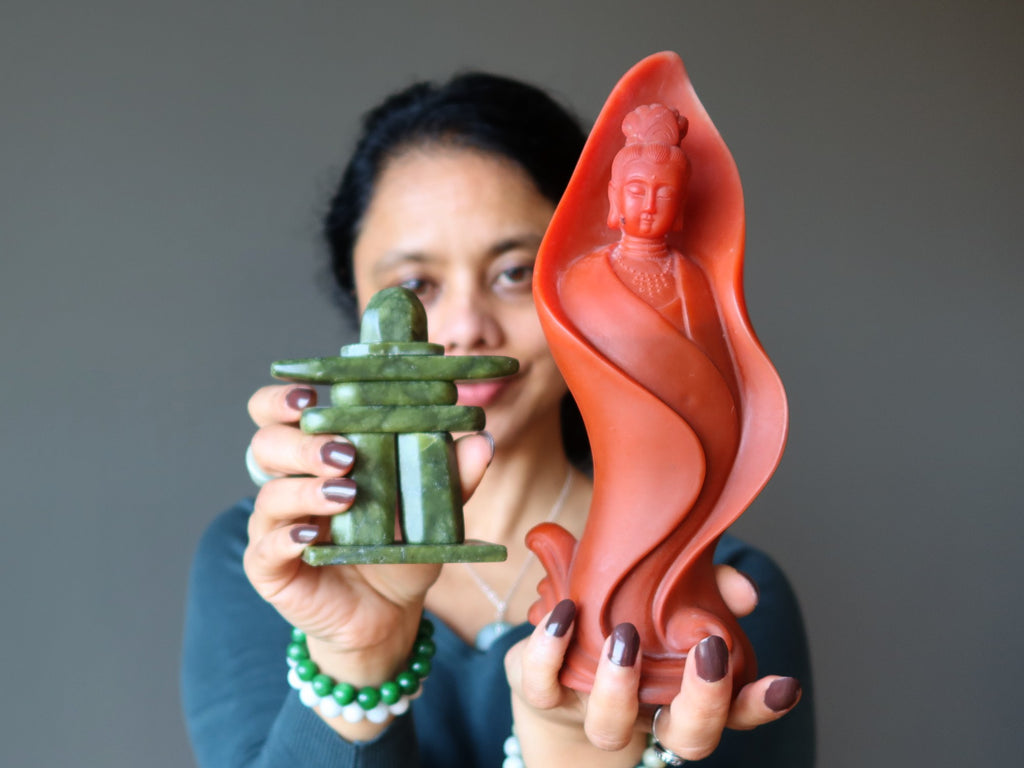
The best way to determine if your Jade is real is to find a reputable seller who knows what they are selling you. If you do not have access to a reputable seller, here are some tips to follow to tell if your Jade is real:
Real Jade is a 6-7 on the Mohs Scale of Hardness. This makes it harder than stainless steel. It will not be scratched by stainless steel (which is a 5 on the Mohs Scale of Hardness). Use your steel keys, knife, or scissors to scratch the surface of the stone. It should not scratch. However, Quartz simulants won't scratch either, and low-grade Jade may scratch in weak spots.
Real Jade will never have air bubbles. Air bubbles are an indication of glass. Use a magnifying jeweler's loupe to help you see into the stone.
Real Jade will have inclusions. Notice your stone's mineral inclusions, veins, craters, dips, and imperfections. You may not find these in a fake.
Real Jade may be magnetic. If there are iron, aluminum, copper, or magnetite inclusions in your stone, your Jade could be slightly magnetic. But in general, Jade is not magnetic on its own.
Real Jade will not leak color. Testing with acetone should not remove any color from the stone. This indicates dyed Jade.
Real Jade will always have a white streak. Despite its outward appearance, Jade will have a white or clear powder in the crystal streak test.
Real Jade is always cold to the touch. It will take a while to heat up in your hands, and once you put it down, it will quickly turn cold again. Some vendors will show that wrapping a strand of hair around Jade and taking a lighter to it won't burn the hair because Jade is so cold. However, many other real gemstones are cold to the touch and won't burn the hair either.
Real Jade has a high-pitched tone that sings like a sweet bell when it's clinked with another piece of real Jade. You want the Jade to hang from a string when striking it; you don't want your hand to dull the sound, and it usually only works with Jade bangles, as seen in YouTube videos. Fake Jade will have a low, dull sound with no lingering reverberation. Plastic will sound hollow. Quartz may sing also.
Real Jade does not usually fluoresce under UV light. Fluorescence is usually an indication of dyed, waxed, or Jade with resin.
Real Jade is heavier than other stones because of its density. It should not feel lightweight when compared to other stones of the same size.
Real Jade should be priced accordingly. Fake Jade can be sold for half the price of Real Jade.
Real Jade has a specific gravity: Jadeite 3.24 to 3.43 and Nephrite 2.90 to 3.03. Here is a video on how to measure your stone's density at home.
Real Jadeite has a refractive index of 1.652-1.688, while Nephrite is 1.6 – 1.67. If you have a refractometer, the stone should fall into this range.
Real Jadeite has a density of 3.3, and Nephrite has a density of 2.95. If you get a Certificate of Authenticity, the Refractive Index and Density should match Jade.
Real Jade cabochons are usually a little rounder on the bottom. They are rarely super flat because the jeweler wants to make the most of the natural Jade material they have available. If you see a super flat rather than domed Jade cabochon bottom, this is an indication that it may be fake.
Real Jade will register as Nephrite or Jade, or on a Gem Tester. This machine can test for real stones vs glass specimens. Note that it will not tell the difference between treated and untreated Jade.
None of these tests is conclusive in itself. The only way to know for sure if your Jade is real is to send it to a certified gemological laboratory. You can also find more tips on the Crystal Identification Help.

You've seen it all over the internet: Jade sellers promising you a Certificate of Authenticity (COA) with your purchase. We hate to break it to you, but their COAs are worth nothing more than the cheap paper it was printed on.
Look closely, it's just a piece of paper that they printed from their home office (often with spelling and grammar mistakes) that they created to make you feel better. COAs have nothing to do with the authenticity of the Jade; it's a marketing gimmick.
Here at Satin Crystals, we are straightforward. No, we don't give you a Certificate of Authenticity because it has no value. The only true way to know if a Jade is real is to have it tested in a reputable laboratory.
If you do see a certificate with the Jade you are purchasing, make sure you understand it thoroughly. Most of the certificates are written in Chinese. Make sure it is a certified laboratory, the values match up to what Jade should register at, and there are no spelling errors.
Here is a fascinating case study by a gemologist who spots Fake Jade on Etsy & Ebay. The very first example shows "Quartzite" named right on the title of the "COA"!
Here is another interesting YouTube video on Is there real Jade on Etsy? She also mentions that certified reports could be doctored. If the seller gets a report for a Real Jade stone and then switches the listing to a different stone, this is a deceptive practice. Make sure you know who you are buying from!
Whereas Nephrite is not as commonly treated as Jadeite, it can be heated to improve its colors. This does break down its stability. You may find Nephrite Jade graded by individual mines and companies, but there is no standard grade yet.
Meanwhile, Jadeite is often treated because of its high demand on the market. Jadeite is broken down into three grades:
A Jade is natural, untreated, with long-lasting, stable color. It could be waxed to bring out its luster, and this is a common practice that does not devalue the piece.
B Jade is treated with acid and bleached to remove oxidation stains, impurities, and lighten the color. It is then impregnated with resin or wax to fill the pores. It is brittle, unstable, changes colors, and has a 5-10% value of "A Jade."
C Jade is treated like "B Jade," plus it is dyed. It has very little value.
B and C Jades will still test as Real Jade on a refractometer. They are still considered Real Jade; they have just been treated. You will need advanced gemological testing to determine their grade.

Faux Jade is an actual gemstone that is being called Jade. Meanwhile, fake Jade can be made of glass, resin, or plastic.
Here are some stone substitutes that vendors try to pass off as Jade. Placing the name Jade in the title of the stone, it makes it easier to sell for a higher price.
Serpentine: New Jade, Afghanistan Jade, Bowenite Jade, Tangiwaite or Tangawaite Jade, Teton Jade, Styrian Jade, Olive Jade, Korean Jade
Dolomite: Mountain Jade
Calcite: Mexican Jade (dyed green Calcite)
Aventurine: Indian Jade
Amazonite: Amazon Jade
Chrysoprase: Australian Jade
Garnet: Transvaal Jade, African Jade, South African Jade
Quartz: Guizhou Jade, Malaysia Jade, Soochow Jade, Honan Jade
Vesuvianite: California Jade (Californite), American Jade
Talc: Manchurian Jade, Shanghai Jade, Fujian Jade, Honan Jade
Soapstone: Korean Jade, Manchurian Jade

If your fake Jade is actually another gemstone, you can definitely use it for healing. You do want to know this upfront, though, so you can program your crystal accordingly.
For example, instead of working with "Australian Jade", you want to know that you actually have Chrysoprase and not Jade. Chrysoprase has benefits that may differ from Jade.
If you are looking to work with Jade, make sure you have true Nephrite or Jadeite Jade.

We have your real Nephrite and Jadeite stones at Satin Crystals. We also have faux Jade, but these are always disclosed in the listings.
Check out the Jade Collection or shop right here on the blog:
Here are other links to tap into Jade energy:
Disclaimer: The metaphysical information provided is for entertainment only. See full disclosure.


This beautifully detailed polar bear is carved from Zebra Calcite stone. This heavy, solid gray striped figurine has an expressive, open-mouthed f...
View full details

Access the spiritual caverns of the ancient Himalayans by meditating with the powerful Amethyst geode. This enlightened purple gem can even rechar...
View full details

Access the spiritual caverns of the ancient Himalayans by meditating with the powerful Amethyst geode. This enlightened purple gem can even rechar...
View full details

Access the spiritual caverns of the ancient Himalayans by meditating with the powerful Amethyst geode. This enlightened purple gem can even rechar...
View full details
Comments
Leave a comment